Train as a Sonographer and play an essential role in modern healthcare — using ultrasound to provide detailed imaging that helps guide patient diagnosis, treatment, and care.
Diagnostic Medical Sonography involves using advanced ultrasound technology. Sonographers capture detailed images that help physicians make informed decisions while providing patients with care, professionalism, and confidence throughout their imaging experience.
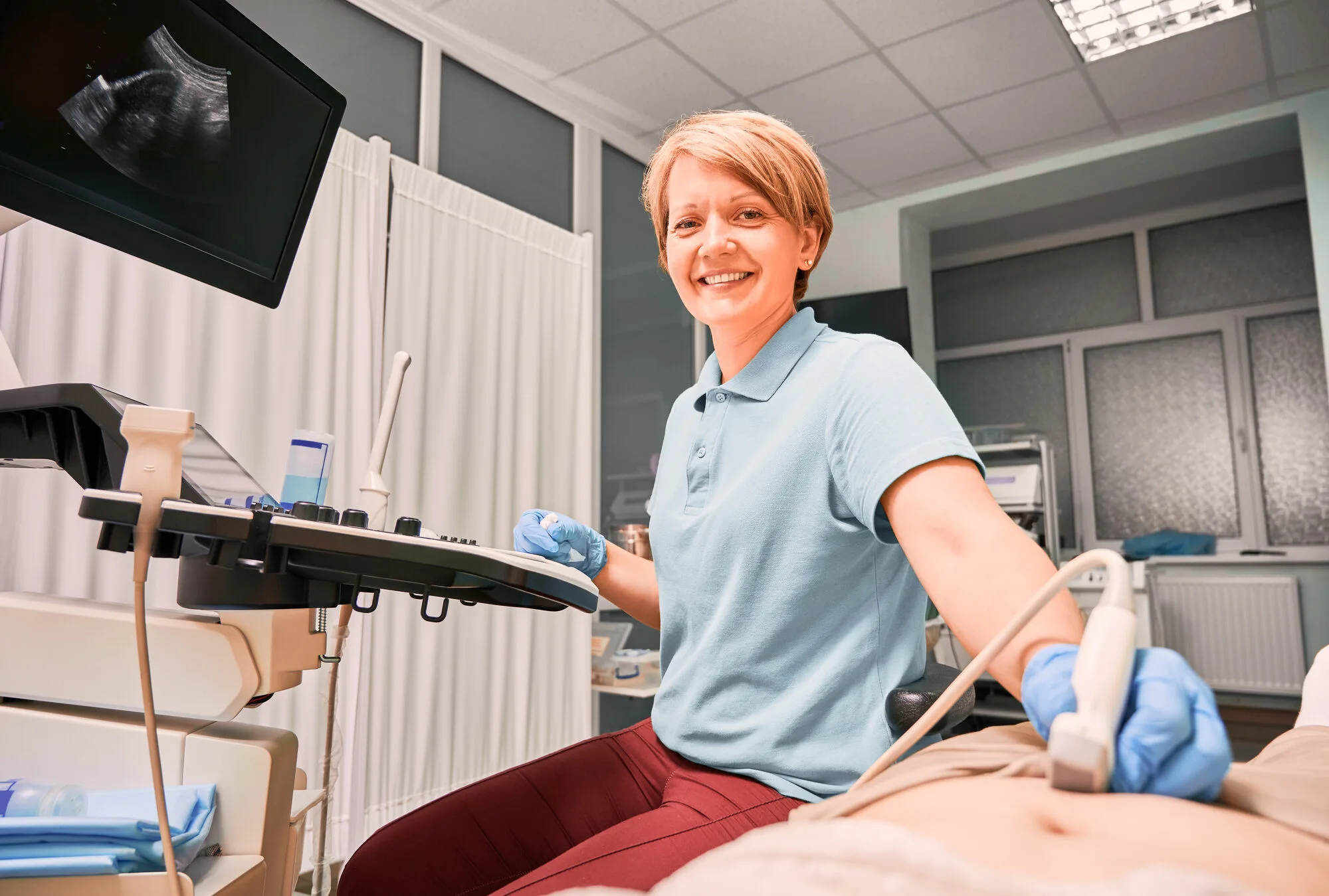
The Diagnostic Medical Sonography program at MCG Career College is a full-time, 80-week program designed to prepare students for a career in diagnostic imaging. Through face-to-face instruction and hands-on on-campus training, students build the knowledge and practical skills needed to perform ultrasound examinations with confidence. Training covers anatomy, patient care, equipment operation, image quality, and scanning techniques in a classroom and supervised lab environment.
Students benefit from small class sizes and 34 weeks of practicum placement with our clinical partners across Canada. Graduates work in clinical settings and are awarded a Diploma in Diagnostic Medical Sonography.
The program is recognized and licensed by Alberta Advanced Education, and government funding may be available to eligible students.
The Diagnostic Medical Sonography program is accredited by Accreditation Canada. Graduates are eligible to sit national examinations that allow them to practise anywhere in Canada.
Graduates can pursue opportunities in hospitals and medical imaging clinics, with the potential to continue building their expertise through ongoing education, certification, and professional development.
Sonographers rank among Canada's most in-demand allied health professionals — with wages that reflect it. Graduates regularly step into full-time roles within weeks of certification.
An intensive 80-week program combining face-to-face campus instruction and 34 weeks of supervised practicum in clinical settings across Canada.
Learn on campus through structured classroom and lab training. You'll build a strong foundation in anatomy, patient care, ultrasound physics, equipment use, and scanning techniques before applying those skills in real clinical settings.
Gain supervised clinical experience with MCG's clinical partners across Canada. You'll apply your training in real healthcare environments, working with patients and ultrasound equipment while learning from credentialed Sonographers in the field.
The DMS admissions process is competitive and multi-stage. Applications for the next intake open in Fall 2026 — here's exactly what to expect.
* Dates represent the current intake cycle and are subject to change. Contact admissions for the most current schedule.
Six terms of focused instruction — from foundational physics and anatomy through to advanced scanning and three full semesters of supervised clinical practicum.
Admission to the DMS program is competitive and multi-stage. All applicants must meet with an MCG Career College Admissions representative, complete both an online, open-response situational judgement test (SJT) and a Spatial Aptitude Assessment, and attend an interview to evaluate their suitability for the program.
According to the Protection for Persons in Care Act, clinical partners require a clear Police Information Check (PIC) including Vulnerable Sector Search (VSS). Any criminal code offence for which a pardon has not been received may be a deterrent to entry into practicum or the program. Where a PIC or VSS is not clear, the College Dean will conduct a formal assessment.
Students must provide proof of completion of the Heart and Stroke Basic Life Support Provider course. Current BLS certification must be maintained throughout the practicum.
Students must be computer literate. The program uses blended learning and technology throughout, including word processing, spreadsheet creation, a learning management system, email management, and web-based activities.
This program may be difficult for students with arm, back, shoulder, wrist, or neck problems due to the physical demands of sonography. Students with concerns are encouraged to speak with College staff and consult their family physician.
Students must have up-to-date immunizations and provide proof prior to starting practicum. Practicum sites require current immunization records and may refuse placement without them — this could prevent successful completion of the program.
All applicants must complete the CASPer (Computer-based Assessment for Sampling Personal Characteristics) test as part of the application phase. CASPer is an open-response situational judgment test that measures aspects of your social intelligence and professionalism, like ethics, empathy, problem-solving and collaboration. Source: Acuity Insights
Tuition includes all course materials, lab supplies, and clinical placement coordination. A non-refundable application fee applies to all applicants: $500.00 for domestic students, $500.00 for international students.
Note: Examination fees for Sonography Canada and ARDMS are not included.
Note: Practicum placements may require travel. Any associated travel costs and living expenses during practicum are the responsibility of the student and are not covered by MCG.
Talk to a real advisor — not a chatbot. Fifteen minutes, no pressure, and we'll map your exact path into the March 2026 intake.